MENA
22/12/2025
The clarification is addressing a verification issue regarding a previously mentioned WIPO article. It was claimed that WIPO’s “IP Around the World” series included a publication covering Spotify and regional intellectual property developments, likely focused on the MENA region. However, upon checking, no official record or confirmed publication date for such an article could be found. This means that the supposed source cannot be treated as an authoritative or official reference. Consequently, any information derived from this unverified source should be considered supplemental commentary rather than formal WIPO data. The clarification emphasizes the importance of verifying sources before citation, especially in academic or professional reporting, to ensure that unconfirmed information is not presented as verified fact, while still acknowledging that it can provide useful background context.
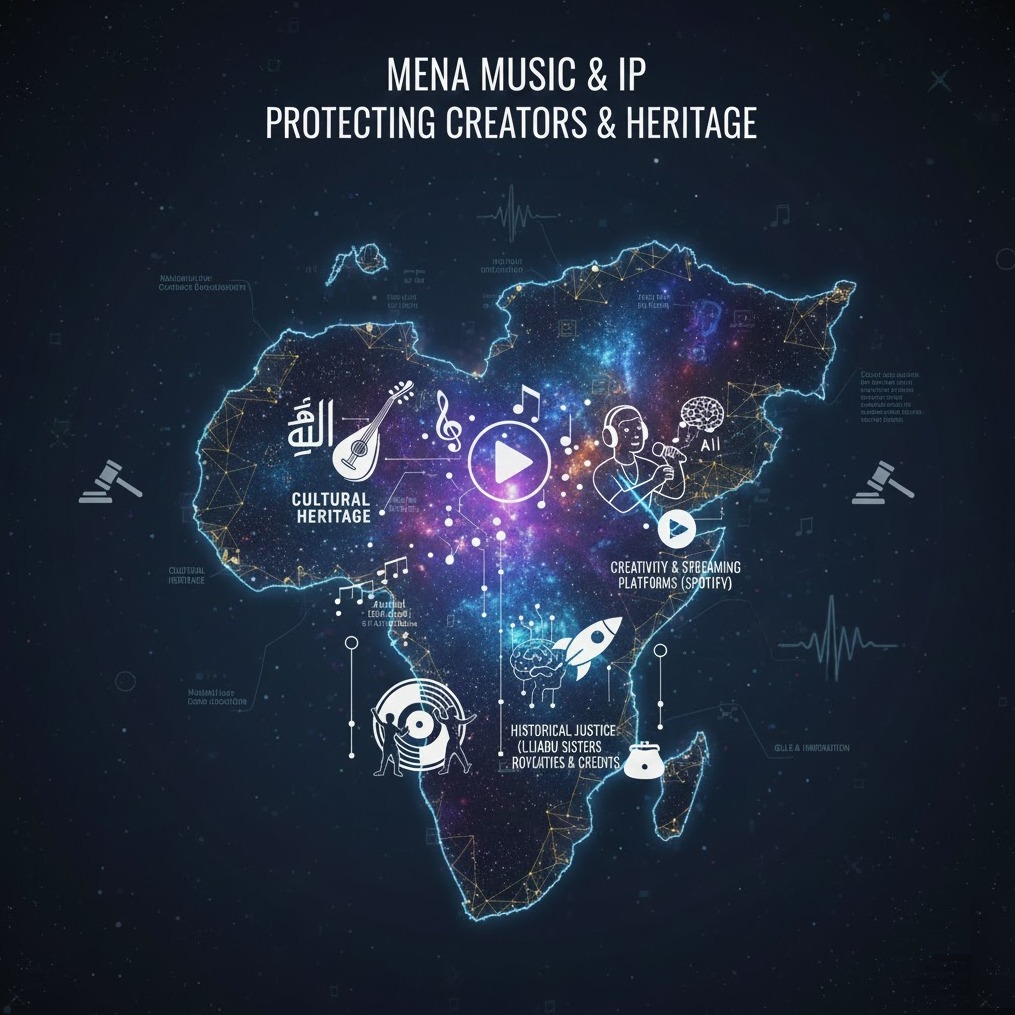
The overall conclusion of the text highlights the multiple roles of intellectual property (IP) in supporting creators, preserving culture, and adapting to new technological realities. Specifically:
-
Cultural Voice & Education – IP empowers artists to express creativity while raising awareness about legal rights. For example, artists like Alsallal use their work to combine artistic expression with education about IP, bridging creativity and legal literacy.
-
Conservation & Livelihoods – Intellectual property mechanisms help protect traditional arts and crafts, enabling communities to monetize their cultural heritage. This ensures that creators benefit economically from their work while preserving cultural practices for future generations.
-
Policy & Innovation – Publications like WIPO’s Music Special encourage policymakers and industry stakeholders to reconsider IP frameworks in light of technological developments, such as AI in music production and distribution. This ensures that IP laws remain relevant and supportive of innovation.
-
Historical Justice & Recognition – IP can also serve as a tool for rectifying past injustices. The case of the Lijadu Sisters shows that reissuing previously unprotected music can restore copyright, give proper credit to artists, and provide royalties, emphasizing IP’s restorative power.
These points collectively demonstrate that IP is not just a legal or economic tool but also a cultural and social framework. It uplifts creators, safeguards heritage, and evolves with technological changes, ensuring that both new and existing works are recognized, valued, and fairly compensated.
Priyanka Gupta