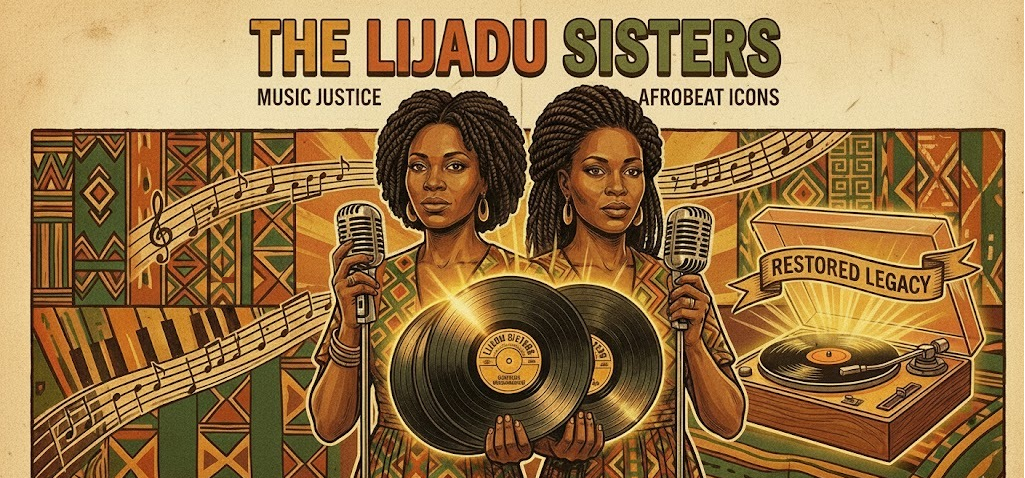
Nigeria – The Lijadu Sisters Reissued: Copyright Revival
20/12/2025
The Lijadu Sisters were trailblazing Nigerian musicians whose work emerged during a period when African music industries lacked strong legal and commercial infrastructure. Although their sound was innovative and socially aware, their recordings were not widely preserved or fairly commercialized. Over time, inadequate documentation of rights, weak copyright enforcement, and limited global access caused their music to fade from mainstream circulation.
This experience was not unique to them. Many artists from underrepresented regions created culturally important works but lacked the legal support needed to protect and sustain their creative output over the long term.
The central issue highlighted by the case of the Lijadu Sisters is the long-standing failure to fairly recognize and compensate artists from underrepresented regions. Although their music held strong artistic and cultural value, it was created at a time when legal awareness, documentation of rights, and enforcement of copyright were weak or absent. As a result, their creative work remained unprotected, poorly distributed, and economically undervalued for decades.
Many artists in similar contexts produced work without formal contracts or with limited understanding of ownership rights. This led to unclear control over recordings, loss of royalties, and unauthorized use of music by third parties. Even when their work continued to influence later generations or gained international appreciation, the original creators and their families were excluded from the financial and reputational benefits.
The issue, therefore, is not only about missing income but also about systemic inequality within cultural and IP frameworks. Traditional copyright systems often operate effectively only when creators have access to legal resources, record-keeping, and industry support—conditions that were largely unavailable to many African and Global South artists in earlier decades.
The key challenge is how intellectual property tools can be used to correct these historical gaps. This involves identifying rightful ownership long after creation, re-establishing legal control over works, and ensuring that renewed commercial exploitation—such as reissues, streaming, or licensing—benefits the creators or their estates. It also raises broader questions about fairness, cultural preservation, and the responsibility of IP systems to serve creators beyond the moment of initial release.
In essence, the issue centers on whether copyright law can move beyond mere protection of new works and instead function as a restorative mechanism—one capable of repairing past neglect, restoring creative dignity, and ensuring equitable treatment for artists whose contributions were overlooked due to structural disadvantages.
The revival of the Lijadu Sisters’ music reveals an important insight into the broader role of intellectual property. Copyright is often understood mainly as a legal or commercial system designed to protect creators at the time their work is released. However, this case demonstrates that copyright can also operate as a restorative mechanism, capable of correcting long-standing neglect and imbalance.
By formally asserting copyright over their recordings many years after their creation, the artists’ estate was able to regain control over how the music was used, distributed, and monetized. This shows that copyright protection does not lose its relevance over time; instead, it can be reactivated to ensure that creative works continue to benefit their rightful owners even decades later.
The insight goes beyond financial recovery. Through lawful reissues and proper attribution, the Lijadu Sisters’ artistic identity was re-established in the global music narrative. Copyright enabled their work to be presented with accurate credit, historical context, and respect for authorship. In this way, IP law supported both economic fairness and cultural recognition.
This case also highlights how rights-based strategies can address inequalities faced by creators from marginalized or underrepresented backgrounds. When intellectual property tools are deliberately and ethically applied, they can help restore balance between cultural contribution and reward, ensuring that creators are not permanently disadvantaged by past structural limitations.
Overall, the key insight is that copyright is not merely a protective rule for new content. It can serve as a powerful instrument for cultural recovery, historical correction, and equitable recognition—allowing overlooked creators to reclaim both their legacy and their rightful place in the creative economy.
The renewed recognition of the Lijadu Sisters demonstrates that intellectual property systems have the capacity to do more than safeguard creativity at the moment of its release. When applied thoughtfully, copyright can help correct historical neglect and restore value to creative works that were overlooked due to structural, economic, or regional disadvantages.
This case shows that past failures in recognition and compensation do not have to be permanent. By revisiting ownership, enforcing rights, and managing creative works responsibly, artists or their estates can reclaim both economic benefits and cultural acknowledgment. The reissue of the Lijadu Sisters’ music proves that creative contributions can regain relevance and generate fair returns even decades later.
Importantly, the outcome highlights the role of copyright in preserving cultural heritage. Protecting and reintroducing older works ensures that significant artistic expressions are not lost to time, while also maintaining respect for authorship and originality. In doing so, intellectual property law supports continuity between generations of creators and audiences.
In conclusion, the case emphasizes that copyright should be viewed not only as a legal safeguard but also as an instrument of fairness and cultural sustainability. When used effectively, it can help ensure that artistic legacies endure with dignity, recognition, and rightful economic reward—especially for creators from underrepresented contexts whose voices were previously marginalized.
Priyanka Gupta