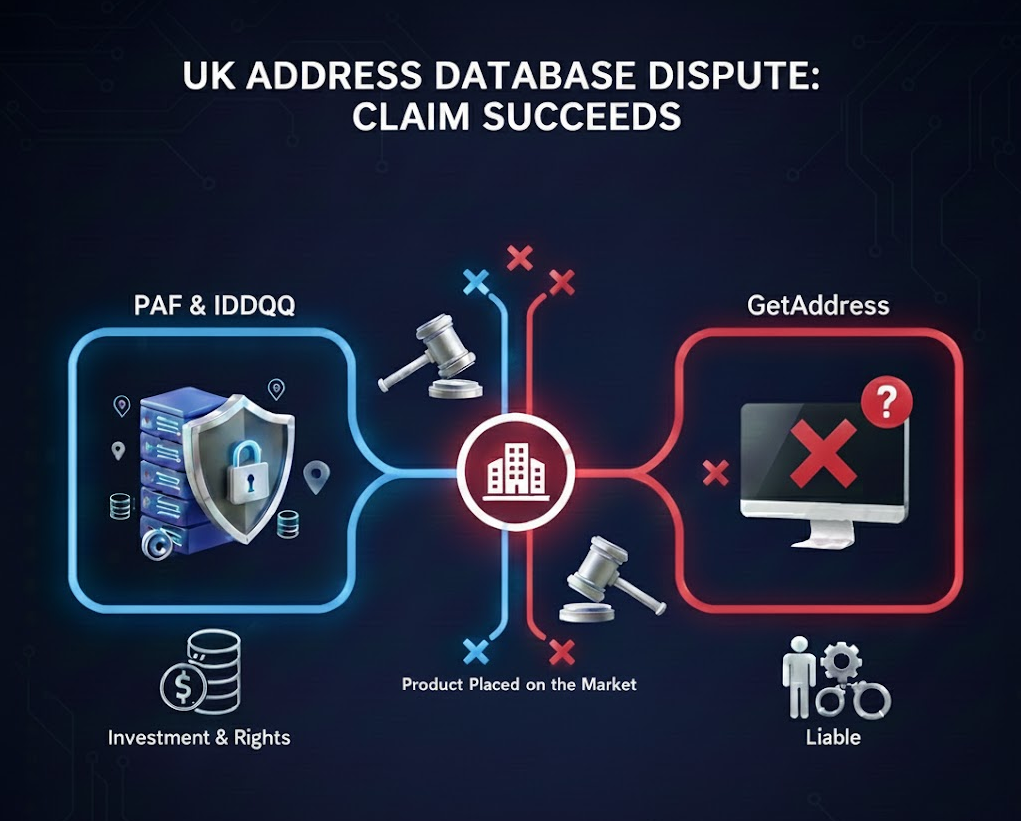
IDDQD and Royal Mail v Codeberry: Claim succeeds in addresses database claim
08/12/2025
In IDDQD Ltd v Codeberry & Smith, Royal Mail Group Ltd v Codeberry & Smith [2025] EWHC 2561 (Ch), the High Court considered claims for copyright and database right infringement concerning UK postal addresses. Every UK postal address has a postcode, combined with other address details, and compiled in the Postcode Address File (PAF). The PAF, originally developed in Norwich in 1959 and extended nationwide over the 1960s and 1970s, was maintained by the Post Office, which became Royal Mail Group (RMG). In 2013, IDDQD created the GBR Database, which built upon the PAF with additional data. In 2014–15, Lee Smith created the GetAddress database and later incorporated Codeberry. RMG and IDDQD alleged that GetAddress had been constructed using the PAF and GBR Database, making Smith and Codeberry liable for copyright and database right infringement. The case also raised issues regarding the inclusion of individual defendants in database infringement claims.
The primary issues were whether copyright and/or sui generis database rights subsisted in the PAF and GBR Database, whether the defendants had infringed these rights, and whether the individual director, Mr Smith, could be held personally liable. Under UK law, copyright in a database arises where the selection or arrangement of data constitutes the author’s own intellectual creation, while sui generis rights protect substantial investment in obtaining, verifying, or presenting the database contents. Key questions included whether copying significant portions of the databases amounted to infringement, as opposed to “mere consultation,” and whether Mr Smith had knowledge sufficient to attract personal liability.
The court found that both the Postcode Address File (PAF) and the enhanced GBR Database were protected databases due to substantial investment. The defendants committed database right infringement by downloading at least of the GBR Database, which included substantial parts of the PAF. The court ruled that this large-scale data transfer went beyond simple on-screen consultation. Furthermore, copyright infringement was established by the copying of historic elements of the PAF. Finally, a director, Mr. Smith, was held personally liable as he was aware of the essential features of the infringing acts and procured them, even without explicit knowledge of the infringement itself.
The decision confirms that both copyright and sui generis database rights can protect continually updated databases and that extracting substantial parts, even years after their creation, can constitute infringement. It also underscores the viability of including individual directors as defendants, provided they are aware of the essential acts giving rise to infringement. For rights holders, this case illustrates that pursuing claims against both companies and key individuals remain a viable strategy in database right and copyright enforcement.
Mahima