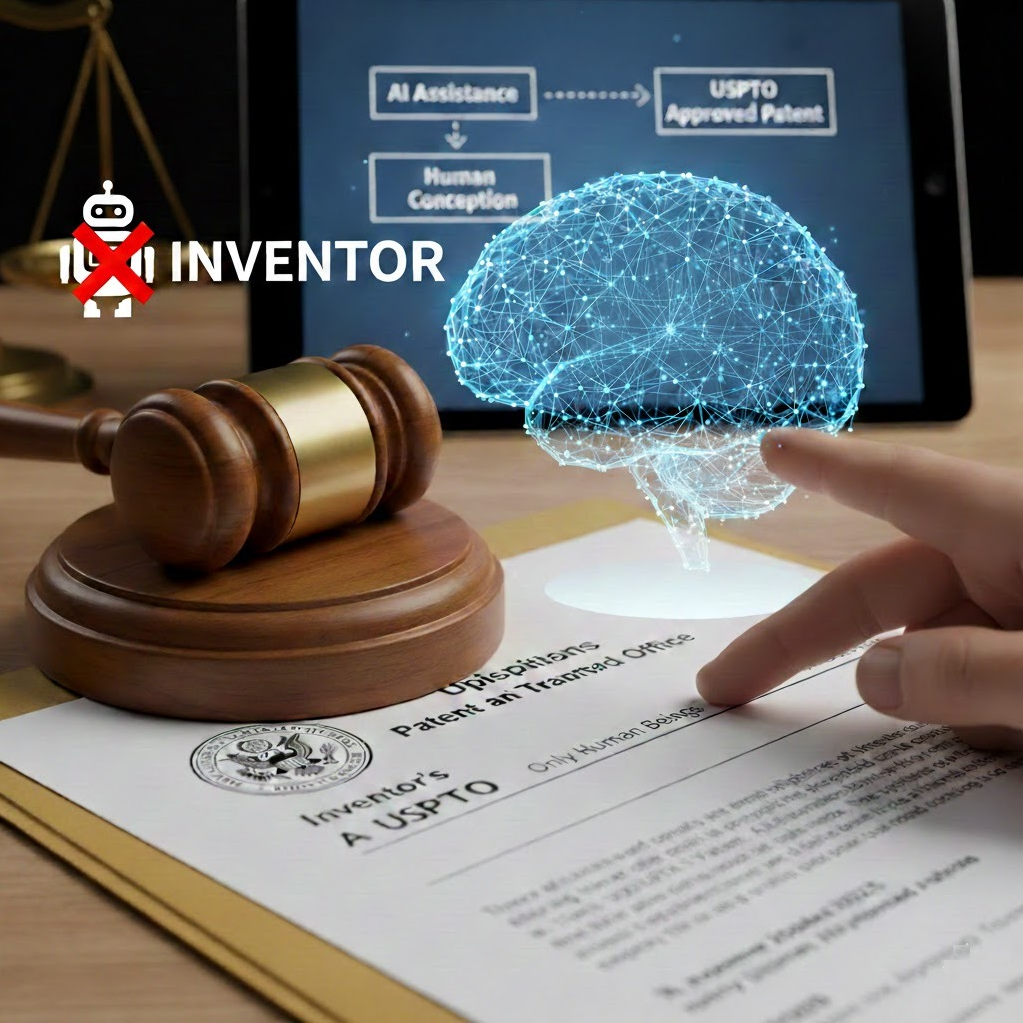
USPTO’S REVISED GUIDANCE ON AI-ASSISTED INVENTIONS
07/02/2026
The rapid emergence of generative artificial intelligence (AI) and advanced computational tools has profoundly transformed technological innovation, blurring traditional boundaries between human creativity and machine-assisted output. Against this backdrop, intellectual property systems worldwide have confronted a fundamental question: What is the role of AI in the invention process, and can AI be recognised as an inventor under patent law? This question is not merely academic; it strikes at the core of the incentives that patent systems are designed to provide—encouraging human ingenuity, disclosure of new ideas, and investment in cutting-edge technologies. In the United States, this issue catalysed a significant evolution in the United States Patent and Trademark Office’s (USPTO) guidance on inventorship for AI-assisted inventions, culminating in the revised guidance issued on November 28, 2025.
At the heart of the debate lies an enduring principle of U.S. patent law: only natural persons may be named as inventors in a patent application. This principle is deeply rooted in statutory interpretation and judicial precedent, which consistently treat inventorship as a product of conception, a mental act involving the formation of a complete and operative idea of the invention, performed by a human being. The Federal Circuit’s decision in Thaler v. Vidal directly reflects this principle, holding that the Patent Act requires inventors to be natural persons and that artificial entities, no matter how sophisticated, do not qualify. This legal threshold frames the entire policy landscape.
The USPTO first articulated specific guidance on AI-assisted inventions in February 2024, issuing what became known as the 2024 Inventorship Guidance. That guidance was promulgated pursuant to the Federal Register to help examiners and stakeholders navigate situations where AI systems had materially assisted the inventive process. It emerged against the backdrop of increased use of generative AI in R&D workflows and the U.S. government’s broader policy focus on safe, secure, and innovative applications of AI, as reflected in President Biden’s Executive Order on the Safe, Secure, and Trustworthy Development and Use of Artificial Intelligence. Under the 2024 guidance, the USPTO instructed examiners to analyse inventorship by applying the Federal Circuit’s Pannu factors—traditionally used to determine joint inventorship among multiple human contributors—to evaluate whether a human’s contribution was significant enough to justify naming them as an inventor when AI assistance was involved.
The Pannu factors require that a purported inventor make a significant contribution to the conception, such that the contribution is not insignificant in comparison with the full invention and does not merely involve explaining well-known concepts. Under this framework, the guidance directed that at least one natural person must meet these criteria for an invention to be patentable when AI played a role. The focus on “significant contribution” was intended to emphasize that mere use of AI, or oversight of an AI process, did not automatically equate to inventorship.
However, the 2024 guidance drew swift and intense public feedback, including from practitioners, industry stakeholders, and academics, who raised concerns about the suitability of applying a joint inventorship framework to AI involvement. Critics argued that Pannu was designed to analyse human-to-human collaboration, not human-to-machine interaction, and that applying it to AI blurred the distinction between assisting tools and inventors. This concern was not theoretical; it reflected a practical tension within patent law. On one hand, the patent system seeks to reward creative breakthroughs, many of which now involve extensive computational assistance; on the other hand, allowing AI to blur the boundaries of inventorship threatens to destabilise the fundamental legal definition of an inventor.
In response to these concerns and after evaluating public comments, the USPTO rescinded the 2024 guidance and issued a Revised Inventorship Guidance for AI-Assisted Inventions on November 28, 2025. This new guidance reaffirmed that existing legal standards for inventorship apply uniformly regardless of AI involvement. It explicitly repudiated the application of Pannu factors to single-inventor situations involving AI systems, emphasising that those factors “only apply when determining whether multiple natural persons qualify as joint inventors.” In other words, where there is only a single human using AI tools to create an invention, there is no joint inventorship question to be analysed under the Pannu framework. Rather, the guidance places conception and human mental contribution back at the centre of the analysis and treats AI strictly as a tool—a sophisticated one, to be sure, but the legal equivalent of laboratory equipment, computer software, or research databases.
The analytical reasoning underlying the revised guidance rests on two core legal pillars: first, the longstanding conception test in U.S. patent law, which requires that a claimant have a complete and operative idea of the invention; and second, the statutory requirement that inventors be natural persons. Under the conception standard, an invention is conceived when the inventor forms a definite and permanent idea of the complete invention, such that only ordinary skill would be required to reduce it to practice. By its nature as a non-conscious computational system, AI cannot form such an idea; it can generate outputs based on patterns in data, but it cannot meet the mental act requirement that defines legal conception. Consequently, even when AI contributes materially to design or ideation, the inquiry must focus on whether the human contributor’s input meets the conception threshold.
Importantly, the revised guidance does not make inventions involving AI any less patentable than those created solely by human ingenuity. The USPTO clarified that AI-assisted inventions remain patentable so long as at least one human contributor meets the existing legal requirements for inventorship. The guidance neither imposes a heightened standard nor requires the disclosure of AI use beyond existing rules; it maintains the presumption that the named inventor or inventors are the actual inventors and will only trigger deeper inventorship scrutiny if the record suggests otherwise. Thus, the policy balances the encouragement of innovation and technological investment with the imperative of maintaining a coherent legal framework for inventorship that incentivizes human creativity.
Analytically, this shift represents a reaffirmation rather than a departure from established legal doctrine. By retreating from the earlier Pannu-based framework, the USPTO acknowledged that conflating AI assistance with human inventorship risked conflating tools with creators. The revised guidance restores clarity by reasserting that AI’s role, no matter how advanced, does not change the legal requirements for inventorship; it simply assists human agents in their creative endeavours. This approach aligns with judicial precedent and mitigates the risk that patents may be issued where no human could meaningfully explain the inventive contribution—a scenario that could undermine both the utility and legitimacy of the patent system.
Given the global landscape, it is also noteworthy that similar principles have been articulated in other jurisdictions, including Europe and common-law countries, where courts have clarified that AI cannot be named as an inventor and that human involvement remains the determining factor. This international context underscores a broader consensus that while AI may enhance the inventive process, the legal institution of a patent remains grounded in human invention.
In conclusion, the evolution of the USPTO’s guidance on AI-assisted inventions reflects a thoughtful and analytically grounded attempt to reconcile the transformative capabilities of AI with the enduring legal architecture of patent law. By retreating from an ill-fitting joint inventorship framework and re-emphasising traditional conception and natural-person requirements, the USPTO has reaffirmed that AI remains a tool—one that can accelerate innovation but cannot itself be an inventor. This conclusion preserves the integrity of the patent system while providing much-needed clarity for innovators navigating the frontiers of AI-assisted creation.
Nandini Kohli